How to Audit Your Business Workflows for Automation Opportunities
Published Mar 17, 2026 · 10 min read
Not every workflow should be automated. An automation audit identifies which ones should be, in what order, and within what governance boundaries.
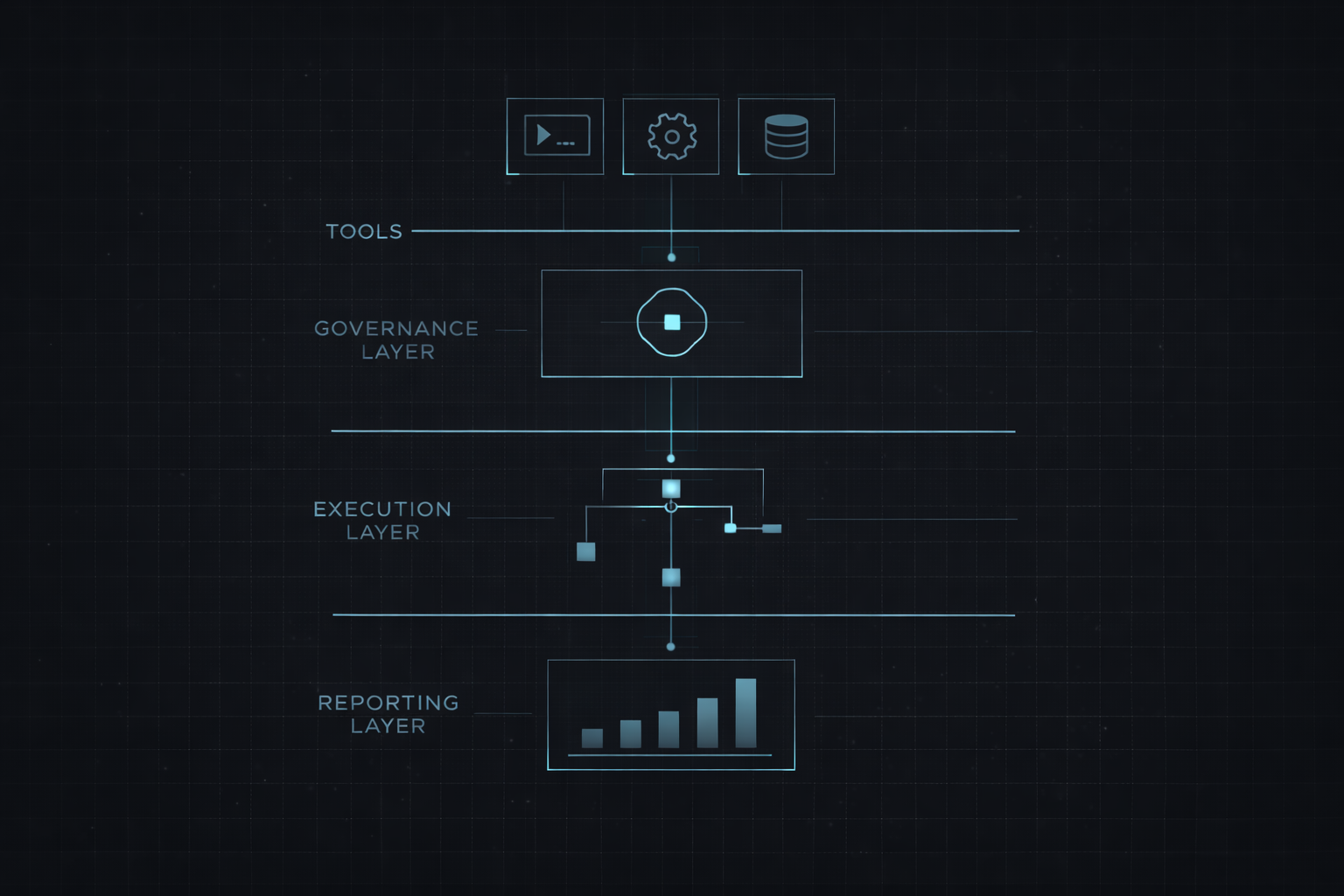
What an automation audit actually measures
An automation audit is not a technology assessment. It does not start by looking at what tools you have or what platforms you could adopt. It starts by mapping your workflows — the actual sequence of steps your team executes to move work from input to output — and measuring where time, money, and quality are being lost.
The audit measures three primary dimensions: friction (where workflows slow down or break), manual hours (how much human time each step consumes), and ROI potential (what the return would be if specific steps were automated). These measurements produce a ranked list of automation opportunities, ordered not by how easy they are to implement, but by how much impact they would have on the overall workflow.
This distinction matters because the easiest automation is rarely the most valuable one. Automating a low-friction step saves minutes. Automating the primary bottleneck saves the downstream time of everything that was waiting behind it. The audit identifies which is which.
The six dimensions of a workflow audit
Identifies where workflows slow down, break, or require manual intervention. Maps handoff points, approval bottlenecks, and data re-entry steps that consume time without adding value.
Quantifies how many hours per week each workflow step consumes in human labor. Distinguishes between labor that requires judgment and labor that is purely mechanical repetition.
Scores each automation opportunity by implementation cost vs time saved. Factors in error reduction, speed improvement, and capacity freed for higher-value work. Not everything worth automating is worth automating first.
Determines which single workflow bottleneck, if resolved, would have the greatest cascading impact across the organization. The primary constraint is the automation opportunity with the highest leverage.
Defines the boundaries for each automation: what it can do, what requires human approval, what is explicitly prohibited. Every automated action operates within an authorization framework.
Calculates a workflow health score using deterministic rules applied to the mapped data. Reproducible, auditable, and comparable over time as automations are deployed and measured.
How constraint identification works for workflows
The same constraint-based methodology that powers our SEO audits applies to workflow automation. The Theory of Constraints says that every system has one bottleneck that limits overall throughput. Fix that bottleneck, and throughput increases until the next constraint becomes primary.
In workflow terms, this means identifying the single step that, if automated or improved, would have the greatest cascading impact across your operations. It might be the data entry step that delays invoicing. It might be the approval step that blocks three downstream teams. It might be the reporting step that consumes 15 hours a week of analyst time that could be spent on analysis instead.
The audit does not just identify this constraint — it quantifies the downstream impact. If the invoicing bottleneck is resolved, how much time is freed in collections? If the approval bottleneck is resolved, how much faster do downstream teams complete their work? This cascading analysis is what turns a list of automation opportunities into a strategic roadmap.
The output is a constraint map: your primary bottleneck, the evidence supporting that identification, secondary constraints ranked by their relationship to the primary issue, and ROI projections for addressing each one. This is the same structure used in our diagnostic methodology — applied to workflows instead of search performance.
When to automate vs when not to
Not everything that can be automated should be. The automation audit explicitly distinguishes between workflow steps that are good automation candidates and steps that should remain human-driven. This distinction is based on predictability, volume, and judgment requirements.
Good automation candidates are high-volume, predictable, and require minimal contextual judgment. Poor automation candidates are variable, require nuanced decision-making, or change frequently enough that maintaining the automation would cost more than the manual effort.
Automate vs. keep manual
- •High-volume data entry between systems
- •Status update notifications across tools
- •Report generation from structured data
- •Scheduling and calendar coordination
- •Invoice processing and reconciliation
- •Decisions that require contextual judgment
- •Client-facing communications needing tone sensitivity
- •Exception handling where the exceptions vary widely
- •Creative work or strategic planning
- •Processes that change frequently and unpredictably
The governance layer for automation changes
Automation without governance is a liability. When a script sends an email, processes a payment, or updates a record, it is acting on behalf of your business. If the automation does something wrong — sends the wrong email, processes a duplicate payment, overwrites good data — the consequences are real and often hard to reverse.
The governance envelope defines the boundaries for each automation. What actions can it take independently? What requires human approval? What is explicitly prohibited? These boundaries are defined during the audit and enforced during implementation. Every automated action operates within its authorization framework, and every action is logged in an immutable record.
This is what separates an automation audit from an automation wishlist. The audit does not just identify what to automate — it defines the governance structure that makes automation safe to deploy. The governance envelope travels with the automation from audit through governed execution, ensuring that the safeguards defined during diagnosis are enforced during implementation.
When you move from audit to execution, the constraint map and governance envelopes become the work specification. Each monthly cycle targets the highest-priority constraint, implements the automation within its governance boundaries, and measures the impact. The re-audit loop then identifies the next constraint, and the cycle continues.
Find your workflow constraint
Start with a diagnostic to identify your primary automation opportunity. Upgrade to a full audit for the complete constraint map, ROI projections, and governance envelopes.