Why serious businesses outgrow drag-and-drop automation
Published Mar 17, 2026 · 10 min read
Low-code automation is fast to set up and easy to understand. Until it isn’t. Here is what changes when your workflows get serious.
The convenience trap
Drag-and-drop automation tools are designed to minimize time-to-first-automation. They succeed at this. You can connect two applications in minutes, set up a trigger, and watch data flow between systems. The value is immediate and the learning curve is gentle.
The convenience trap reveals itself over months, not minutes. As your workflows multiply, each one adds maintenance surface area. When an API changes, Zaps break silently. When a workflow needs modification, you are editing a visual flowchart that has grown beyond what the interface can cleanly display. When you need to understand why an automation did what it did last Tuesday, the logs tell you it ran — but not the decision chain that led to that execution.
The cost of low-code automation is not the subscription price. It is the cumulative maintenance burden that grows with every workflow you add, compounded by the lack of tooling that professional software development takes for granted.
What you lose with visual builders
Visual builders store logic in proprietary formats. You cannot diff a Zap. You cannot review a Make scenario in a pull request. When something changes, you have no record of what it was before.
You cannot write unit tests for a Zapier workflow. You cannot run integration tests against a staging environment. The only test is production — and production is where your clients live.
Drag-and-drop tools offer retry or fail. Custom code offers retry with exponential backoff, fallback to alternate endpoints, partial rollback, alerting with context, and graceful degradation.
When your business rules require nested conditions, lookups, and multi-source validation, visual builders become unreadable flowcharts. Code handles complexity without losing clarity.
Per-task pricing on Zapier means costs scale linearly with volume. Custom automation has near-zero marginal cost per execution once deployed.
What custom automation gives you
Custom Python automation is code you own, running on infrastructure you control, executing logic designed for your specific business rules. It is not a black box — it is a transparent system where every decision point is explicit and every action is auditable.
Version control means every change is tracked, reviewed, and reversible. Testing means you catch failures before they reach production. Error handling means your automations degrade gracefully instead of failing silently. Conditional logic means your business rules are expressed in code, not approximated in flowchart boxes.
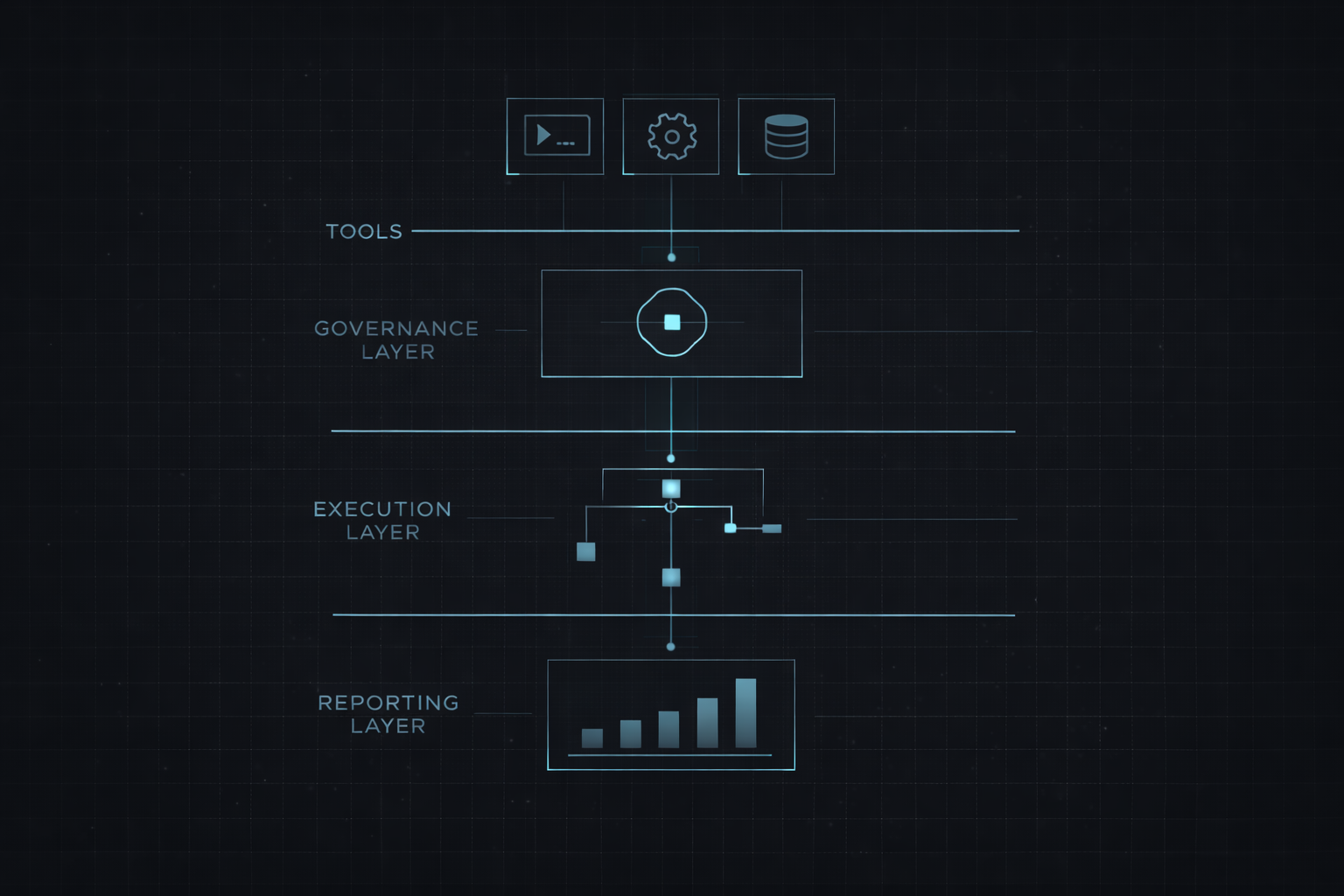
Governance controls sit at every decision point. Before an automation sends an email, processes a payment, or updates a client record, the proposed action is presented for human review. The approval is logged. The execution is measured. The result is compared against the expected outcome.
This is not about writing code for the sake of writing code. It is about having the tools and controls that professional operations require — the same tools software teams have relied on for decades, applied to business automation.
Real cost comparison
The pricing comparison between Zapier and custom automation is not straightforward because the cost structures are fundamentally different. Zapier charges per task — every execution costs money. Custom automation has a fixed implementation and operational cost, with near-zero marginal cost per execution.
At low volume, Zapier is cheaper. At high volume, the math reverses. And the cost comparison does not capture the value of governance, audit trails, and error recovery — capabilities that drag-and-drop tools simply do not offer.
- •$750+/mo at high-volume tiers
- •Per-task pricing — costs scale linearly
- •Additional costs for premium connectors
- •Maintenance time debugging visual workflows
- •No governance layer — risk exposure unquantified
- •$500 Digital Presence Audit, $750 Automation Audit, or subscriptions from $1,000/month
- •Near-zero marginal cost per execution
- •All integrations included — no connector fees
- •Code-level debugging with stack traces and logs
- •Governance built in — reduced compliance risk
The governed execution model
Every automation change in our system follows the same lifecycle: propose, approve, execute, measure. The automation identifies what should happen. A human reviews and approves the action. The system executes within its governance envelope. The result is measured and logged.
This model means that automation changes are documented, approved, and measurable. When a workflow is modified, the change is version-controlled with a clear record of what changed, who approved it, and what the impact was. This is the same rigor that software engineering applies to production deployments — applied to your business automation.
The governed execution model is not slower. It is safer. The approval step takes seconds when the proposed action is clearly correct. But when the proposal reveals an edge case or misconfiguration, that same approval step prevents an error that would have taken hours to unwind.
Custom doesn’t mean slow
The assumption that custom automation means long timelines is outdated. Our diagnostic identifies your highest-ROI automation opportunity. The full automation audit maps your complete workflow landscape, ranks opportunities by impact, and defines governance envelopes within two weeks.
From audit to first deployed automation, the timeline is measured in weeks, not months. Each automation is scoped to a specific workflow, built to your business rules, tested against real data, and deployed with governance controls from day one. Speed comes from constraint — knowing exactly what to build because the audit already identified the highest-leverage opportunity.
See what custom automation looks like for your workflows
Start with a free diagnostic to identify your highest-leverage automation opportunity, or jump to a full audit for the complete picture.
Read more: Custom automation vs Zapier · Automation audit in Dallas · Automation audit in Boston